
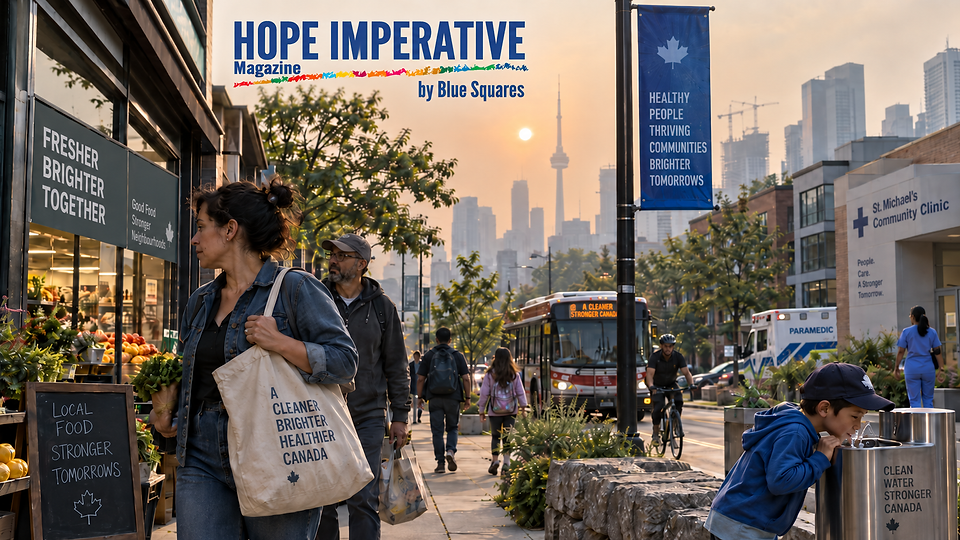
Canada’s own 2026 SDG report says more than three-quarters of its domestic indicators are off track. Behind the numbers are housing costs, food insecurity, health-care access, unsafe drinking water and a climate changing faster than the country is adapting. Four years can be an election cycle. It is not much time to build hundreds of thousands of homes, repair strained health systems, eliminate long-term drinking water advisories, reduce poverty, protect ecosystems and prepare communities for a climate that is already changing. Yet a little more than four years is what remains before 2030, the deadline Canada accepted when it joined every other United Nations member state in adopting the Sustainable Development Goals in 2015. For much of the past decade, 2030 sounded distant enough to be aspirational. Governments could announce strategies, establish targets, create reporting frameworks and talk about progress measured in years. That distance has disappeared. Canada's latest accounting of its own performance offers an uncomfortable measure of where the country now stands. According to Canada's 2026 Annual Report on the 2030 Agenda and the Sustainable Development Goals, just four per cent of indicators in the Canadian Indicator Framework had achieved their targets. Another 21 per cent were on track. Just over 75 per cent were not. More than half of those off-track indicators were deteriorating. That is not a prediction of failure. Nor does it mean Canada has made no progress since 2015. It does mean the period when ambition could substitute for results is ending. And the evidence of that gap is increasingly easy to find without opening a UN report. It is there in the rent payment that consumes an unsustainable share of a household's income. It is in a grocery bill that forces choices between food and other essentials. It is in the patient waiting for care, the community still living under a drinking-water advisory and the municipality trying to protect roads, homes and public buildings from flood, fire or extreme heat. The Sustainable Development Goals can sound abstract when presented as 17 coloured boxes. They become considerably less abstract when understood as a test of what life in Canada is actually becoming. Two scorecards, one warning There is an important complication in Canada's SDG numbers. The country tracks progress using both the UN's Global Indicator Framework and a separate Canadian Indicator Framework designed around domestic priorities. The global framework paints a less severe picture. As of February 2026, almost 20 per cent of the measurable global indicators tracked for Canada had achieved their targets and another 25 per cent were on track. Fifty-six per cent were not on track, including 26 per cent showing deterioration. The domestic framework is considerably tougher: four per cent achieved, 21 per cent on track and more than three-quarters off track. The numbers are not contradictory. They measure different things. That distinction matters because the Canadian framework brings the conversation closer to conditions people encounter here: poverty, food insecurity, health, water, infrastructure, communities, inequality, climate and public institutions. It is possible, in other words, for Canada to make measurable progress internationally while still struggling against the standards it has set for itself at home. And some of the weakest areas are among the most familiar. Housing: the 2030 agenda begins at the front door If Canadians were asked to name the country's most immediate sustainability problem without being shown the SDGs, housing would almost certainly be near the top of the list. That is exactly the point. Housing is not separate from sustainable development. It sits at the intersection of income, health, infrastructure, transportation, energy, inequality and community. Under Canada's domestic framework, Sustainable Development Goal 11 — sustainable cities and communities — contains five indicators classified as deteriorating in the 2026 assessment. The scale of the housing challenge is difficult to reconcile with the time left before 2030. Canada Mortgage and Housing Corporation estimated in 2025 that restoring housing affordability to levels last seen in 2019 would require between 430,000 and 480,000 new homes annually over the following decade. That would amount to roughly double the pace of construction assumed under business-as-usual conditions. CMHC stresses that the estimate is not an official government target; it is a measure of the scale of the supply problem. There has been movement. Housing starts increased six per cent in 2025 to about 259,000 units, with record rental construction in several major cities. Missing-middle construction also increased. But CMHC's 2026 housing supply assessment warned that strong headline numbers conceal weaknesses, particularly in housing intended for ownership and in future project pipelines in Toronto and Vancouver. That is the tension running through much of Canada's SDG record: progress can be real and still be insufficient. A new apartment building matters. A faster approval system matters. More rental construction matters. But the test is not whether Canada is building something. It is whether the country is building enough of the right housing, in the right places, at prices people can reasonably afford. For a household spending too much of its income on shelter, the distinction between "progress" and "on track" is not semantic. It is monthly. Food insecurity in a country of plenty The contradiction is just as sharp at the grocery store. Canada is one of the world's major agricultural producers and food exporters. Yet in 2024, about 9.8 million people — 24 per cent of the population — lived in households reporting some form of food insecurity. The rate declined slightly from 25.7 per cent in 2023, ending three consecutive annual increases. But it remained dramatically higher than in 2020, when the rate was 15.8 per cent. Nearly half of people living in one-parent families experienced food insecurity in 2024. Rates were also considerably higher among racialized and Indigenous people than among their respective comparison groups. Statistics Canada's own assessment of SDG progress has warned that most food and hunger indicators are not on track for their 2030 targets, pointing to food insecurity, price volatility and sustainable agriculture among the challenges. Again, the SDG language can obscure how ordinary the problem has become. Food insecurity does not always mean an empty refrigerator. It can mean buying less nutritious food because it is cheaper, reducing portions, skipping meals, worrying that food will run out or reallocating money from another bill to make the grocery budget work. Statistics Canada defines the measure around inadequate or insecure access to food because of financial constraints. That makes it an income story as much as a food story. Canada's official poverty rate stood at 11 per cent in 2024, essentially unchanged from the year before. The broader lesson is that economic growth, employment and aggregate national wealth do not automatically produce food security. An SDG can be missed in one of the world's wealthiest countries not because food does not exist, but because access to it is uneven. Health care: universal does not always mean accessible Health presents another Canadian paradox. The country has a universal publicly funded health-care system that remains central to its national identity. At the same time, access to that system has become an increasingly visible source of strain. In Canada's domestic SDG assessment, Goal 3 — good health and well-being — had eight indicators classified as deteriorating, more than any other goal in the Canadian framework. Recent Statistics Canada research adds a human scale to that result. Using 2024 survey data, researchers found that 18 per cent of Canadians aged 45 and older — about 2.9 million people — reported unmet health-care needs. Among people in the same age group, 27.8 per cent reported difficulty accessing specialist care. Problems obtaining appointments and long waits between booking and seeing a specialist were among the most common difficulties. These figures do not mean Canada's health-care system is failing everywhere or for everyone. They do show why measuring health only by whether a service formally exists is inadequate. Access has a time dimension. A family physician who is theoretically part of a universal system but unavailable to take new patients does not provide meaningful access to the person searching for one. A specialist appointment months away may eventually provide care, but delay itself can become part of the health burden. The SDG promise is not simply that Canadians will possess health insurance cards. It is that people will be able to live healthier lives. Those are not the same thing. Clean water and the unfinished work of reconciliation Few Canadian examples make the distance between a basic development goal and lived reality clearer than drinking water in First Nations communities. There has been substantial progress. As of Aug. 13, 2026, Indigenous Services Canada reported that 156 long-term drinking-water advisories on public systems on reserves had been lifted since November 2015. But 40 remained in effect across 38 communities. And new advisories continue to become long-term. The drinking-water advisory affecting the Cross Lake Natimek public water system in Manitoba crossed the one-year threshold on Aug. 13. It affected 248 homes and six community buildings. Two weeks earlier, an advisory at Wahpeton Dakota Nation in Saskatchewan had also become long-term. A long-term advisory is not simply an infrastructure statistic. It means water may be unsafe to drink or use. Advisories may be triggered by equipment failures, poor filtration or disinfection, water-line breaks or other failures within the system. The progress since 2015 deserves recognition because it demonstrates that persistent problems can be solved. Treatment plants have been upgraded. Distribution systems have been repaired. Advisories have been lifted. But progress also creates a harder question. If Canada has demonstrated the technical and institutional ability to resolve more than 150 long-term advisories, why are dozens still in effect — and why are new ones still becoming long-term? The 2030 Agenda repeatedly uses the phrase "leave no one behind." In Canada, that principle eventually reaches a tap. Either safe water comes out of it or it does not. Climate change is running on a different clock Some 2030 targets can be moved by legislation, budgets and political choices. Climate change is less patient. On Sept. 3, Environment and Climate Change Canada released its second major national scientific assessment of how the country's climate is changing. The report found that Canada warmed by 2 C between 1948 and 2023, while the North warmed by 2.6 C. Since 1970, Canada has warmed nearly twice as fast as the global average, with the Canadian Arctic warming three times as fast. The assessment describes changes that are no longer theoretical: more extreme heat, longer fire seasons, shrinking snow and ice cover, thawing permafrost, changing streamflow, warming oceans and rising sea levels. And some additional warming in the near term is unavoidable. Canada's average temperature is projected to rise by about another 0.9 C over the 2021-to-2040 period across emissions scenarios. That changes the meaning of climate action. Reducing greenhouse-gas emissions remains essential. But adaptation — preparing communities for climate impacts already locked in — is now equally tangible. The financial case is becoming difficult to ignore. Canada's 2026 National Adaptation Strategy Progress Report estimates climate hazard-related losses are already averaging $9.2 billion annually and could double within eight years. Municipal adaptation needs alone are estimated at $5.3 billion a year, while municipalities are responsible for roughly 60 per cent of Canada's public infrastructure. Research cited by the federal government suggests every dollar invested in adaptation can avoid as much as $15 in costs elsewhere in the economy. In August, Ottawa and the Federation of Canadian Municipalities announced $34.2 million for 141 climate-resilience projects in 128 communities. The projects range from cooling measures in Halifax parks and flood-resilient infrastructure in Port Coquitlam to extreme-heat mitigation in Waterloo housing and flood reduction in Kanesatake. These are not spectacular climate projects. That may be their greatest strength. A drainage system, cooling plan, flood map or resilient road rarely produces the imagery of a wind farm or a major transit project. But successful adaptation is often invisible. Its achievement is the disaster that causes less damage, the home that does not flood or the person who survives an extreme-heat event. Sustainable development is sometimes built through things that do not happen. The problem with 17 separate boxes One of the weaknesses in public discussion about the SDGs is the tendency to treat each goal as an independent file. Housing belongs to Goal 11. Hunger belongs to Goal 2. Health belongs to Goal 3. Water belongs to Goal 6. Climate belongs to Goal 13. Life does not organize itself that neatly. A household struggling with rent has less money available for food. Food insecurity affects health. Poor health can affect employment and income. Extreme heat can increase pressure on health systems. Flooding can destroy housing. Climate damage can strain municipal budgets that also pay for transit, water systems and other infrastructure. And the effects are not evenly distributed. The people with the fewest financial resources often have the least ability to absorb rising rents, relocate after disaster, retrofit a home, take unpaid time away from work or navigate delayed services. That is why inequality runs through almost every other sustainable-development target. The SDGs are most useful not as a collection of international promises, but as a map of systems that collide in real life. Canada's 2026 results suggest the central problem is no longer identifying those connections. It is acting at the speed they require. Progress is real. So is the gap. There is a risk in reporting a national scorecard this weak. A list of deteriorating indicators can quickly become an argument for fatalism: the targets were unrealistic, the problems are too large, 2030 is too close, government moves too slowly. The evidence does not support that conclusion either. Canada has lifted 156 long-term drinking-water advisories since 2015. Rental housing construction reached record levels in several major cities in 2025. Hundreds of communities are undertaking climate-adaptation work. The proportion of Canadians experiencing food insecurity declined modestly in the latest annual data after three years of increases. And Canada's SDG report itself contains areas where targets have been reached or where progress is on track. The domestic framework shows stronger performance in areas including some infrastructure and partnership indicators. None of that cancels the warning contained in the larger numbers. It changes the question from whether progress is possible to whether progress can become fast enough, broad enough and durable enough to matter by 2030. That is a more demanding standard. Announcements are not outcomes. Pilot projects are not systems. Funding commitments are not completed infrastructure. National averages are not proof that everyone has benefited. The remaining years of the 2030 Agenda will increasingly expose the difference. What hope looks like when the deadline is real Hope is easy when the deadline is distant. The more useful kind begins when the numbers are difficult to ignore. Canada does not need to "win" the Sustainable Development Goals as though they were an international ranking. Nor will Jan. 1, 2031 suddenly make housing affordable, eliminate hunger or end climate risk. The value of the deadline is more practical. It forces a country that made promises in 2015 to look at the results. By 2030, Canadians should be able to ask straightforward questions. Is a decent home more affordable? Are fewer people worried about having enough food? Can patients get the care they need when they need it? Do First Nations communities have the same expectation of safe drinking water as everyone else? Are cities and towns better prepared for the fires, floods and heat that climate science says are coming? Are public institutions measuring improvement by money announced, or by conditions changed? Those questions are harder than the language of sustainability strategies. They are also more useful. The 2030 deadline will not arrive as a delegation from the United Nations. It will arrive as another rent payment. Another grocery bill. Another specialist appointment. Another summer of smoke, heat or flooding. Another morning when someone turns on the tap. Canada's own indicators are saying that, on too many of those measures, the country is not yet where it promised to be. There is still time to change the trajectory. But there is no longer much time to confuse intention with progress. 2030 is coming either way. The question is what kind of Canada will meet it.
Canada’s own 2026 SDG report says more than three-quarters of its domestic indicators are off track. Behind the numbers are housing costs, food insecurity, health-care access, unsafe drinking water and a climate changing faster than the country is adapting. Four years can be an election cycle. It is not much time to build hundreds of thousands of homes, repair strained health systems, eliminate long-term drinking water advisories, reduce poverty, protect ecosystems and prepare communities for a climate that is already changing. Yet a little more than four years is what remains before 2030, the deadline Canada accepted when it joined every other United Nations member state in adopting the Sustainable Development Goals in 2015. For much of the past decade, 2030 sounded distant enough to be aspirational. Governments could announce strategies, establish targets, create reporting frameworks and talk about progress measured in years. That distance has disappeared. Canada's latest accounting of its own performance offers an uncomfortable measure of where the country now stands. According to Canada's 2026 Annual Report on the 2030 Agenda and the Sustainable Development Goals, just four per cent of indicators in the Canadian Indicator Framework had achieved their targets. Another 21 per cent were on track. Just over 75 per cent were not. More than half of those off-track indicators were deteriorating. That is not a prediction of failure. Nor does it mean Canada has made no progress since 2015. It does mean the period when ambition could substitute for results is ending. And the evidence of that gap is increasingly easy to find without opening a UN report. It is there in the rent payment that consumes an unsustainable share of a household's income. It is in a grocery bill that forces choices between food and other essentials. It is in the patient waiting for care, the community still living under a drinking-water advisory and the municipality trying to protect roads, homes and public buildings from flood, fire or extreme heat. The Sustainable Development Goals can sound abstract when presented as 17 coloured boxes. They become considerably less abstract when understood as a test of what life in Canada is actually becoming. Two scorecards, one warning There is an important complication in Canada's SDG numbers. The country tracks progress using both the UN's Global Indicator Framework and a separate Canadian Indicator Framework designed around domestic priorities. The global framework paints a less severe picture. As of February 2026, almost 20 per cent of the measurable global indicators tracked for Canada had achieved their targets and another 25 per cent were on track. Fifty-six per cent were not on track, including 26 per cent showing deterioration. The domestic framework is considerably tougher: four per cent achieved, 21 per cent on track and more than three-quarters off track. The numbers are not contradictory. They measure different things. That distinction matters because the Canadian framework brings the conversation closer to conditions people encounter here: poverty, food insecurity, health, water, infrastructure, communities, inequality, climate and public institutions. It is possible, in other words, for Canada to make measurable progress internationally while still struggling against the standards it has set for itself at home. And some of the weakest areas are among the most familiar. Housing: the 2030 agenda begins at the front door If Canadians were asked to name the country's most immediate sustainability problem without being shown the SDGs, housing would almost certainly be near the top of the list. That is exactly the point. Housing is not separate from sustainable development. It sits at the intersection of income, health, infrastructure, transportation, energy, inequality and community. Under Canada's domestic framework, Sustainable Development Goal 11 — sustainable cities and communities — contains five indicators classified as deteriorating in the 2026 assessment. The scale of the housing challenge is difficult to reconcile with the time left before 2030. Canada Mortgage and Housing Corporation estimated in 2025 that restoring housing affordability to levels last seen in 2019 would require between 430,000 and 480,000 new homes annually over the following decade. That would amount to roughly double the pace of construction assumed under business-as-usual conditions. CMHC stresses that the estimate is not an official government target; it is a measure of the scale of the supply problem. There has been movement. Housing starts increased six per cent in 2025 to about 259,000 units, with record rental construction in several major cities. Missing-middle construction also increased. But CMHC's 2026 housing supply assessment warned that strong headline numbers conceal weaknesses, particularly in housing intended for ownership and in future project pipelines in Toronto and Vancouver. That is the tension running through much of Canada's SDG record: progress can be real and still be insufficient. A new apartment building matters. A faster approval system matters. More rental construction matters. But the test is not whether Canada is building something. It is whether the country is building enough of the right housing, in the right places, at prices people can reasonably afford. For a household spending too much of its income on shelter, the distinction between "progress" and "on track" is not semantic. It is monthly. Food insecurity in a country of plenty The contradiction is just as sharp at the grocery store. Canada is one of the world's major agricultural producers and food exporters. Yet in 2024, about 9.8 million people — 24 per cent of the population — lived in households reporting some form of food insecurity. The rate declined slightly from 25.7 per cent in 2023, ending three consecutive annual increases. But it remained dramatically higher than in 2020, when the rate was 15.8 per cent. Nearly half of people living in one-parent families experienced food insecurity in 2024. Rates were also considerably higher among racialized and Indigenous people than among their respective comparison groups. Statistics Canada's own assessment of SDG progress has warned that most food and hunger indicators are not on track for their 2030 targets, pointing to food insecurity, price volatility and sustainable agriculture among the challenges. Again, the SDG language can obscure how ordinary the problem has become. Food insecurity does not always mean an empty refrigerator. It can mean buying less nutritious food because it is cheaper, reducing portions, skipping meals, worrying that food will run out or reallocating money from another bill to make the grocery budget work. Statistics Canada defines the measure around inadequate or insecure access to food because of financial constraints. That makes it an income story as much as a food story. Canada's official poverty rate stood at 11 per cent in 2024, essentially unchanged from the year before. The broader lesson is that economic growth, employment and aggregate national wealth do not automatically produce food security. An SDG can be missed in one of the world's wealthiest countries not because food does not exist, but because access to it is uneven. Health care: universal does not always mean accessible Health presents another Canadian paradox. The country has a universal publicly funded health-care system that remains central to its national identity. At the same time, access to that system has become an increasingly visible source of strain. In Canada's domestic SDG assessment, Goal 3 — good health and well-being — had eight indicators classified as deteriorating, more than any other goal in the Canadian framework. Recent Statistics Canada research adds a human scale to that result. Using 2024 survey data, researchers found that 18 per cent of Canadians aged 45 and older — about 2.9 million people — reported unmet health-care needs. Among people in the same age group, 27.8 per cent reported difficulty accessing specialist care. Problems obtaining appointments and long waits between booking and seeing a specialist were among the most common difficulties. These figures do not mean Canada's health-care system is failing everywhere or for everyone. They do show why measuring health only by whether a service formally exists is inadequate. Access has a time dimension. A family physician who is theoretically part of a universal system but unavailable to take new patients does not provide meaningful access to the person searching for one. A specialist appointment months away may eventually provide care, but delay itself can become part of the health burden. The SDG promise is not simply that Canadians will possess health insurance cards. It is that people will be able to live healthier lives. Those are not the same thing. Clean water and the unfinished work of reconciliation Few Canadian examples make the distance between a basic development goal and lived reality clearer than drinking water in First Nations communities. There has been substantial progress. As of Aug. 13, 2026, Indigenous Services Canada reported that 156 long-term drinking-water advisories on public systems on reserves had been lifted since November 2015. But 40 remained in effect across 38 communities. And new advisories continue to become long-term. The drinking-water advisory affecting the Cross Lake Natimek public water system in Manitoba crossed the one-year threshold on Aug. 13. It affected 248 homes and six community buildings. Two weeks earlier, an advisory at Wahpeton Dakota Nation in Saskatchewan had also become long-term. A long-term advisory is not simply an infrastructure statistic. It means water may be unsafe to drink or use. Advisories may be triggered by equipment failures, poor filtration or disinfection, water-line breaks or other failures within the system. The progress since 2015 deserves recognition because it demonstrates that persistent problems can be solved. Treatment plants have been upgraded. Distribution systems have been repaired. Advisories have been lifted. But progress also creates a harder question. If Canada has demonstrated the technical and institutional ability to resolve more than 150 long-term advisories, why are dozens still in effect — and why are new ones still becoming long-term? The 2030 Agenda repeatedly uses the phrase "leave no one behind." In Canada, that principle eventually reaches a tap. Either safe water comes out of it or it does not. Climate change is running on a different clock Some 2030 targets can be moved by legislation, budgets and political choices. Climate change is less patient. On Sept. 3, Environment and Climate Change Canada released its second major national scientific assessment of how the country's climate is changing. The report found that Canada warmed by 2 C between 1948 and 2023, while the North warmed by 2.6 C. Since 1970, Canada has warmed nearly twice as fast as the global average, with the Canadian Arctic warming three times as fast. The assessment describes changes that are no longer theoretical: more extreme heat, longer fire seasons, shrinking snow and ice cover, thawing permafrost, changing streamflow, warming oceans and rising sea levels. And some additional warming in the near term is unavoidable. Canada's average temperature is projected to rise by about another 0.9 C over the 2021-to-2040 period across emissions scenarios. That changes the meaning of climate action. Reducing greenhouse-gas emissions remains essential. But adaptation — preparing communities for climate impacts already locked in — is now equally tangible. The financial case is becoming difficult to ignore. Canada's 2026 National Adaptation Strategy Progress Report estimates climate hazard-related losses are already averaging $9.2 billion annually and could double within eight years. Municipal adaptation needs alone are estimated at $5.3 billion a year, while municipalities are responsible for roughly 60 per cent of Canada's public infrastructure. Research cited by the federal government suggests every dollar invested in adaptation can avoid as much as $15 in costs elsewhere in the economy. In August, Ottawa and the Federation of Canadian Municipalities announced $34.2 million for 141 climate-resilience projects in 128 communities. The projects range from cooling measures in Halifax parks and flood-resilient infrastructure in Port Coquitlam to extreme-heat mitigation in Waterloo housing and flood reduction in Kanesatake. These are not spectacular climate projects. That may be their greatest strength. A drainage system, cooling plan, flood map or resilient road rarely produces the imagery of a wind farm or a major transit project. But successful adaptation is often invisible. Its achievement is the disaster that causes less damage, the home that does not flood or the person who survives an extreme-heat event. Sustainable development is sometimes built through things that do not happen. The problem with 17 separate boxes One of the weaknesses in public discussion about the SDGs is the tendency to treat each goal as an independent file. Housing belongs to Goal 11. Hunger belongs to Goal 2. Health belongs to Goal 3. Water belongs to Goal 6. Climate belongs to Goal 13. Life does not organize itself that neatly. A household struggling with rent has less money available for food. Food insecurity affects health. Poor health can affect employment and income. Extreme heat can increase pressure on health systems. Flooding can destroy housing. Climate damage can strain municipal budgets that also pay for transit, water systems and other infrastructure. And the effects are not evenly distributed. The people with the fewest financial resources often have the least ability to absorb rising rents, relocate after disaster, retrofit a home, take unpaid time away from work or navigate delayed services. That is why inequality runs through almost every other sustainable-development target. The SDGs are most useful not as a collection of international promises, but as a map of systems that collide in real life. Canada's 2026 results suggest the central problem is no longer identifying those connections. It is acting at the speed they require. Progress is real. So is the gap. There is a risk in reporting a national scorecard this weak. A list of deteriorating indicators can quickly become an argument for fatalism: the targets were unrealistic, the problems are too large, 2030 is too close, government moves too slowly. The evidence does not support that conclusion either. Canada has lifted 156 long-term drinking-water advisories since 2015. Rental housing construction reached record levels in several major cities in 2025. Hundreds of communities are undertaking climate-adaptation work. The proportion of Canadians experiencing food insecurity declined modestly in the latest annual data after three years of increases. And Canada's SDG report itself contains areas where targets have been reached or where progress is on track. The domestic framework shows stronger performance in areas including some infrastructure and partnership indicators. None of that cancels the warning contained in the larger numbers. It changes the question from whether progress is possible to whether progress can become fast enough, broad enough and durable enough to matter by 2030. That is a more demanding standard. Announcements are not outcomes. Pilot projects are not systems. Funding commitments are not completed infrastructure. National averages are not proof that everyone has benefited. The remaining years of the 2030 Agenda will increasingly expose the difference. What hope looks like when the deadline is real Hope is easy when the deadline is distant. The more useful kind begins when the numbers are difficult to ignore. Canada does not need to "win" the Sustainable Development Goals as though they were an international ranking. Nor will Jan. 1, 2031 suddenly make housing affordable, eliminate hunger or end climate risk. The value of the deadline is more practical. It forces a country that made promises in 2015 to look at the results. By 2030, Canadians should be able to ask straightforward questions. Is a decent home more affordable? Are fewer people worried about having enough food? Can patients get the care they need when they need it? Do First Nations communities have the same expectation of safe drinking water as everyone else? Are cities and towns better prepared for the fires, floods and heat that climate science says are coming? Are public institutions measuring improvement by money announced, or by conditions changed? Those questions are harder than the language of sustainability strategies. They are also more useful. The 2030 deadline will not arrive as a delegation from the United Nations. It will arrive as another rent payment. Another grocery bill. Another specialist appointment. Another summer of smoke, heat or flooding. Another morning when someone turns on the tap. Canada's own indicators are saying that, on too many of those measures, the country is not yet where it promised to be. There is still time to change the trajectory. But there is no longer much time to confuse intention with progress. 2030 is coming either way. The question is what kind of Canada will meet it.